Why Automation Is Critical for Precision Metals
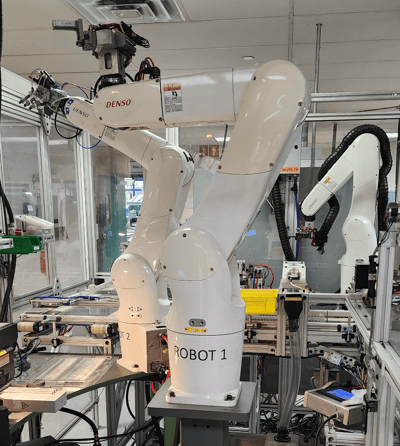
In precision metals manufacturing, especially in the medical space, there are extremely tight tolerances (and very high stakes). Those tolerances must be maintained across high production volumes, which can be difficult when using manual processes.
Manual manufacturing processes have the potential to introduce variability through several factors, such as:
- Part handling
- Environmental conditions
- Operator technique
- Operator fatigue
It’s because of the way manual processes are designed that even the most highly skilled operators can find themselves challenged to maintain identical results.
Automation is able to address this challenge by stabilizing production processes. Yes, artificial intelligence and automated processes must be trained and calibrated, but once they are, these automated systems can perform the same operations time and time again with a level of consistency unlike that of solely manual processes.
The consistency provided by automation helps the MedTech manufacturing process in several ways, such as through:
- Precision: Automated systems are able to better control both position and motion.
- Repeatability: Every part is produced under the same operating conditions, ensuring consistent results.
- Scalability: Manufacturers can ramp up production without worrying about sacrificing quality.
- Process stability: Automated systems maintain performance across long runs.
How does this work so well?
We take precise measurements and feed that data directly into the next machining operation. The system automatically sends the measurement data to the CNC machine, which then adjusts the machining offsets before the next step begins.
George Warman
Director of Automation R&D at Vantedge Medical
Remember, too, that the automated methods of this feedback loop mean that precision is maintained not just across one or two manufacturing stages, but across all of them. There is no need to wait for the final inspection to identify issues, as automated systems can quickly check for and detect variations and adjust processes earlier in production, before a potential issue arises.
These capabilities are vital across all types of applications, but they are of the utmost importance in those like surgical stapling. In this application, mechanical performance requires extremely precise component geometry, and an error could be extremely serious for a patient on the operating table.
Surgical Stapling: Where Precision Becomes Non-Negotiable
Surgical stapling is a system that plays a vital role in many of the modern surgical procedures performed today. These devices allow surgeons to quickly close tissues (and maintain consistency), especially during minimally invasive operations. Surgical stapling offers a range of benefits, from increasing the speed of suturing wounds to providing for consistent tension and the reduction of operating time compared to traditional suturing. That’s why there is so much at stake.
The performance of these stapling systems relies completely on the precision of their underlying parts. One error can mean staples don’t line up or fail to perform as expected, leading to real issues for the surgeon and patient.
That’s why it is necessary to keep an eye on all critical components. One of the most critical areas of the stapling device is the staple anvil pocket, which both guides and forms the staple as it is deployed. If the anvil pocket isn’t formed correctly, then the staple won’t be formed properly, either. The tight tolerances that staple pockets require can be difficult to maintain through manual processes, but automated manufacturing and inspection systems help ensure surgical-grade specifications.
Automation helps improve several aspects of surgical stapling production, including supporting consistent component alignment, performing regular, high-precision inspections of critical features, maintaining repeatable machining operations, and offering stable manufacturing processes at scale.
We have automated welding cells that take two components and perform the welding operation automatically. Then the parts move into automated assembly processes where robots pick and place components through the next stages.
George Warman
Director of Automation R&D at Vantedge Medical
Beyond machining automation, production workflows can also benefit from automation. Vantedge uses purpose-built automation integrated with engineering and manufacturing to ensure high-quality parts make it out of production and into procedures where they can do the most good.
Inspection Automation: The Key To Scaling Without Risk
While manufacturing precise components is necessary, the reality is that it can’t happen without quality controls in place. Inspection processes need to keep up with the flow of components and ensure that all components meet strict dimensional and functional requirements to work correctly together.
Traditionally, inspectors would have manually evaluated components, one by one, with microscopes and measurement tools. Manual inspection can be effective when you’re looking at small production volumes, but when production scales, it is nearly impossible to keep up.
Human inspectors can only evaluate a limited number of parts within any given shift, and visual inspections can be affected by anything from fatigue to long inspection cycles.
In some applications, manual inspection is still required. However, when someone must examine parts through a microscope for extended periods, maintaining the same level of focus and accuracy can become challenging after reviewing dozens of images. This is where automated vision systems can help improve consistency and support higher inspection volumes.
George Warman
Director of Automation R&D at Vantedge Medical
Automated inspection systems take away a large portion of the risk by embedding measurement and defect detection into the process. These systems are able to analyze the components at a high speed, improving efficiency while ensuring consistency.
Today’s AI-assisted vision systems have improved these capabilities even beyond what automated systems could do in the past with traditional programming.
In recent years, we’ve expanded into AI-enabled vision systems that analyze large inspection datasets and allow systems to be trained far faster than traditional programming approaches.
George Warman
Director of Automation R&D at Vantedge Medical
AI-assisted vision systems are powerful because the AI can evaluate large datasets of components in just moments. It can review images and identify defects effectively, helping:
- Identify any variations in staple pocket geometry
- Flag if there are deviations from specifications in real time
- Determine if there are manufacturing defects
- Compare new components to references to ensure consistency
That matters because it means AI systems can evaluate more data than humans can manually in the same amount of time. Additionally, it’s possible to add more quality checkpoints throughout production, even going so far as to periodically isolate parts for quality review. These automated checkpoints help with quality control, ensuring that component issues are caught early and reducing the risk of defects reaching later production or the end customer.
Why In-House Automation Is the Best Choice
.png?width=500&height=374&name=image%20(36).png)
Many of the third-party manufacturers who exist today use third-party automation integrations. These help them design or implement production systems, giving them tools and expert advice. Third-party services aren’t always good, though. They can be complicated to work with when trying to scale, adjust processes, or manage quality.
Vantedge works differently. Instead of outsourcing automation development, the internal automation team is responsible for designing, building, deploying, and integrating automation systems that standardize components. The team uses a standardized automation architecture to perform a full range of work in-house, ranging from mechanical design and robotics programming to automation cell fabrication and production implementation.
Beneficially, in-house automation also enables faster iteration when you need processes to change. An in-house team knows the ins and outs of the system and can respond faster than when working with a third party, while maintaining alignment with production operations and understanding the company's specific needs.
Working with an in-house team is protective; it reduces the complexity of working with third-party vendors and helps you maintain tighter control over your intellectual property, research, and design.
Benefits of Automation as a System
Automation’s greatest value is shown when it’s implemented as a part of the overall manufacturing strategy, not just a single segment of it. At Vantedge Medical, we use automation integrated across engineering, production, and inspection workflows, employing a system-level approach that improves the efficiency and effectiveness of the manufacturing process.
This approach to automation helps support transitions from new product introduction to full-scale production by ensuring early manufacturing processes go as smoothly as possible, making later stages less likely to have issues.
With their speed and efficiency, automated systems offer strong support for production scalability. They don’t require downtime and can operate continuously, making them a great option for larger-scale operations or companies that believe they will scale in the future. Additionally, production volume can increase without the risk of a decrease in quality due to potential human error.
Another important point is that by using in-house automation, you’re supporting domestic manufacturing.
By developing these systems internally and keeping production here, we have better control over schedules, costs, and delivery timelines.
George Warman
Director of Automation R&D at Vantedge Medical
With domestic manufacturing, you’re able to better respond to production needs and have stronger insight into the quality of what’s being produced. In terms of operational accountability, there is nothing like keeping the development of your automation systems internal. It increases operational accountability and reinforces just how important it is to create reliable systems that produce high-quality end products.
When you build the system internally, you feel directly responsible for how that product performs for the customer and ultimately for the patient.
George Warman
Director of Automation R&D at Vantedge Medical
For Surgical Stapling, In-House Automation Matters
Precision metals manufacturing for medical devices demands an extraordinary level of process control — because in surgical stapling, there is no room for error.
Even small variations in geometry or alignment can affect device performance and surgical outcomes, leading to longer surgery times, extended recovery times, or injury.
That’s why it’s so important to keep a close eye on production with quality inspections, particularly as production volumes increase. Maintaining high consistency is challenging with manual processes, but automation offers a real solution.
Automation stabilizes manufacturing operations, improves inspection accuracy, and helps you scale production safely and effectively. At Vantedge Medical, automation is embedded directly into our engineering and manufacturing processes. We use purpose-built internal systems, combined with automated machining, AI-assisted inspection, and integrated production workflows, to produce high-quality components required in MedTech manufacturing.
In applications where reliability is critical, such as surgical stapling, automation plays a core role in producing consistent, preferred components that deliver the performance surgeons and patients depend on.
Contact Vantedge Medical today to learn about our internal automation center of excellence and to get started on your next project. Partner with us as your proven partner in medical technology manufacturing.